
A refuse compactor truck is not a "one-size-fits-all" asset, and larger bodies are not inherently superior. An 8m³ compactor targets tight alleys and short transit cycles, a 12m³ model balances urban collection density, and a 16m³ unit serves high-volume arterial routes. Selection must align with actual waste density, legal axle limits, and daily transfer distances.
What information should you collect before choosing capacity?
Before evaluating body volume or issuing tenders, fleet operators must audit their route conditions and collection logistics:
Daily Waste Volume: The total expected mass (kg/day or tons/day) and uncompacted volume generated per route.
Waste Density and Moisture Content: Loose density (kg/m³) and leachate levels across residential, commercial, or market sectors.
Container Specifications: Total count, mechanical standards (e.g., EN 840), and nominal volumes (such as 120L, 240L, 660L, or 1100L).
Distance to Disposal/Transfer Sites: Round-trip transit distance (km) from collection zones to transfer stations or regional landfills.
Road Geometry and Clearances: Minimum roadway widths (m), tight turning radii at intersections, low utility cables, and bridge height restrictions.
Infrastructure Weight Limits: Maximum legal gross vehicle weight (GVW) and individual axle load caps (tons/axle) enforced along municipal transit corridors.
Collection Frequency and Duty Cycles: Targeted trips per day, total working hours per operational shift, and crew availability.
Workforce and Maintenance Support: Driver licensing categories, local technician familiarity with hydraulic systems, and spare parts availability.
How do 8m³, 12m³ and 16m³ trucks differ?
Choosing between 8 m³, 12 m³ and 16 m³ bodies requires balancing chassis ratings, street access and haul distance.
Decision criterion | 8 m³ | 12 m³ | 16 m³ |
|---|---|---|---|
Typical environment | Narrow streets and short local routes | Standard mixed urban routes | Wide arterial roads and high-volume routes |
Manoeuvrability | Highest | Balanced | Lowest; needs more turning space |
Trip pattern | More trips on long hauls | Moderate trip frequency | Fewer trips where legal payload permits |
Typical platform | Light-to-medium-duty 4×2 | Medium-duty 4×2 | Heavy-duty 4×2 or 6×4, subject to axle limits |
Main limitation | Limited capacity on distant routes | Compromise between agility and payload | Street width, bridge and axle-load constraints |
Why does waste density matter more than nominal volume?
A common mistake is treating body volume as a fixed hauling weight. The true constraint is legal net payload, not internal geometric space.
Commercial and dry packaging waste: Lower density can fill body volume before reaching the chassis weight limit.
General urban household waste: Mixed moisture and organic content produce moderate density and variable compaction.
Organic market and food waste: High moisture can reach axle or GVW limits before the body is volumetrically full.
Theoretical hauled mass (kg) = body volume (m³) × compacted density (kg/m³).
Legal weight check: chassis tare + compactor tare + hauled mass ≤ permitted GVW.
If a high-compaction mechanism compresses high-moisture organic waste beyond chassis axle tolerances, the vehicle will commit road-overload violations long before reaching maximum volumetric capacity. Vehicle capacity must always be engineered against verified mass, axle weight distribution, and road regulations.
When is an 8m³ truck the better choice?
Suitable Operating Scenarios
Constrained Urban Alleys: Historic residential zones, high-density city alleys, or informal settlements where vehicle width cannot exceed narrow margins.
Short Landfill Transit Radii: Routes situated close to municipal transfer centers where high cycle frequency does not cause high fuel penalties.
Strict Road-Impact Limitations: Secondary suburban streets or residential paving vulnerable to surface rutting from heavy, tandem-axle commercial vehicles.
Auxiliary Feeder Fleets: Functioning as satellite collector vehicles feeding localized compaction transfer stations.
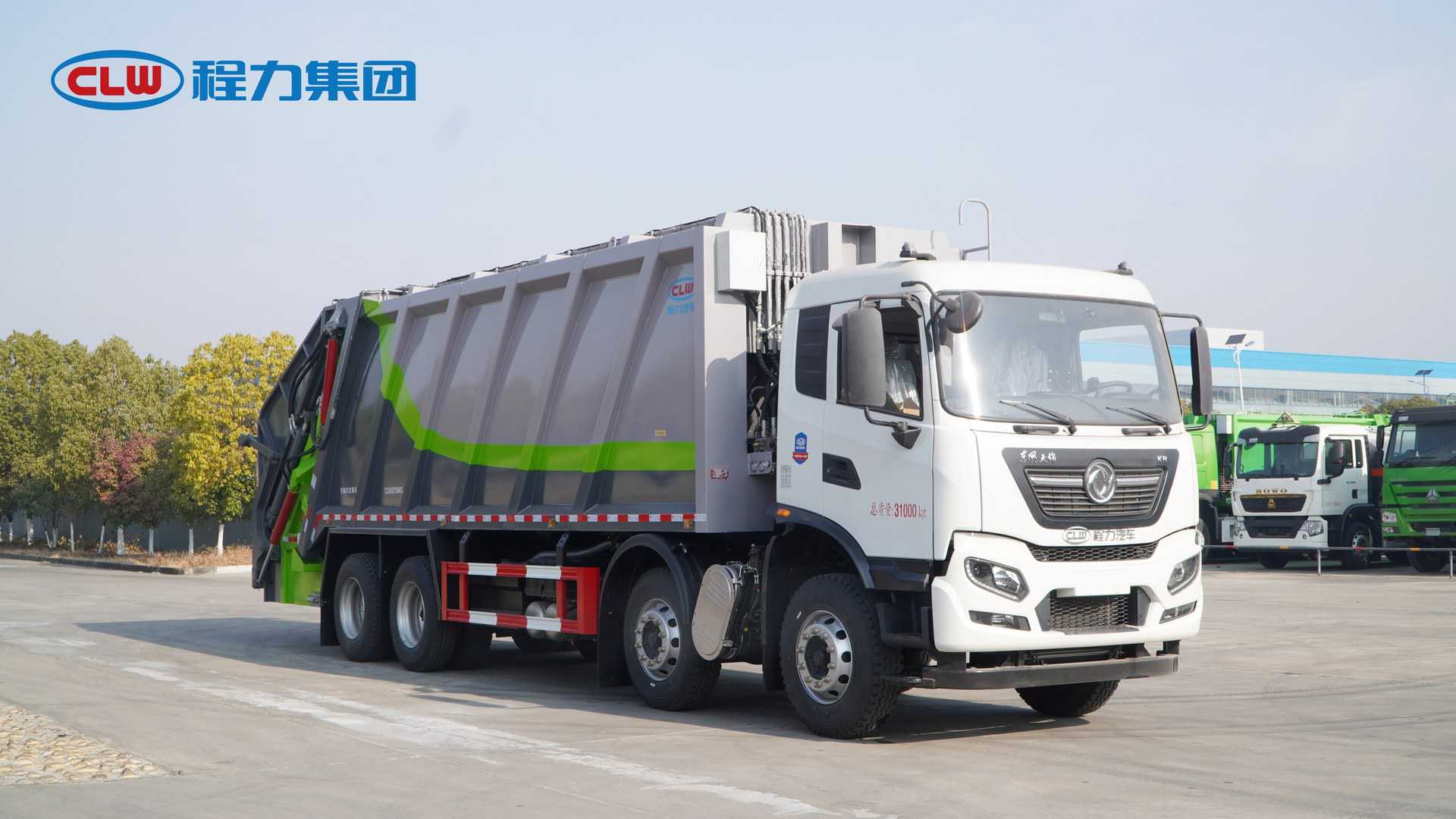
Unsuitable Operating Scenarios
Long-Distance Hauls: Disposal facilities located far from collection routes, where low per-trip volume causes excessive fuel use and wasted driver hours.
Mass Industrial Collection: Industrial parks or bulk collection points generating high volumes of waste that quickly overwhelm small collection bodies.
When should buyers choose 12m³ or 16m³?
Route profile | Starting point |
|---|---|
Narrow alleys and short transfers | 8 m³ platform |
Standard urban routes | 12 m³ platform |
Wide roads and longer disposal hauls | 16 m³ platform, subject to legal payload |
When to Select a 12m³ Compactor
The 12m³ compactor serves as the backbone workhorse for standard municipal fleets:
General Municipal Routes: Ideal for standard two-lane urban streets, regular suburban collections, and perimeter commercial zones.
Balanced Working Shifts: Sufficient capacity to collect standard daily residential loops in one to two continuous routes per driver shift.
Optimal Payload-to-Footprint Ratio: Fits on standard medium-duty single-axle chassis platforms without triggering heavy-chassis operating permits or excessive road wear fees.
Limitation: Cannot navigate narrow historic lanes accessible by 8m³ units, and may require extra trips compared to 16m³ units on long routes to distant disposal sites.
When to Select a 16m³ Compactor
The 16m³ compactor is built for high-throughput logistics:
Distant Landfills & Transfer Stations: Delivers maximum legal payload per run, cutting fuel costs, toll fees, and driver hours over long hauls.
High-Volume Arterials & Commercial Hubs: Ideal for wide avenues, high-density apartment complexes, major commercial plazas, and industrial hubs.
Consolidated Shift Logistics: Allows single-crew teams to collect large volumes over broad collection zones before discharging.
Limitation: Requires wide streets, large turning spaces, and structural road ratings that can support multi-axle platforms.
Which bin lifter should be specified?
A compactor's processing speed depends on selecting the right rear lifting mechanism:
Comb Lifters: Designed for EN 840 two-wheeled mobile garbage bins (120L, 240L, and standard 360L). Suitable for residential curb collections.
Trunnion Arm Lifters: Designed for EN 840 four-wheeled commercial containers (660L and 1100L) using side-lifting steel trunnion pins.
Dual-Purpose Integrated Lifters: Combines a top comb bar with folding trunnion arms to process 120L through 1100L bins on the same collection route.
Integrated Skip Hoist / Rear Winch Systems: Heavy hydraulic arms or winches that load ground-level bulk skips (typically 2m³ to 5m³) directly into the rear hopper.
Engineering Requirement: Bin specifications cannot be assumed. Suppliers must verify your local bin lip styles, rim profiles, and trunnion pin dimensions against mechanical clearance drawings before final manufacturing.
What are the most common capacity-selection mistakes?
Sizing by Population Alone: Calculating fleet size purely from demographic census counts while ignoring local collection frequencies, road access limits, and waste moisture.
Confusing Volume with Legal Weight: Assuming that an 8m³, 12m³, or 16m³ body will legally transport that exact volumetric equivalent in tons.
Omitting Bulk Density in Procurement RFQs: Ordering compactors without specifying whether the target stream is light dry recyclables or heavy organic wet waste.
Overlooking Transit Distance to Landfills: Buying small-capacity bodies for routes with long hauls to disposal sites, creating vehicle bottlenecks and burning excess fuel.
Ignoring Street Clearances and Turning Geometry: Purchasing 16m³ multi-axle chassis for routes with tight corner radii, low utility lines, or dead-end cul-de-sacs.
Procuring Advanced Electronic Controls Without Local Support: Ordering complex CAN bus systems in areas that lack diagnostic tools, wiring schematics, or trained maintenance technicians.
Frequently Asked Questions
Is a 12m³ compactor enough for a municipal route?
For standard residential sectors with planned daily or alternate-day collection cycles, a 12m³ compactor is typically the industry standard. It balances good street passability with enough volume to complete full neighborhood routes without frequent dumping trips.
How many bins can one truck collect?
Total bin count depends on the nominal volume of the bins (such as 120L, 240L, or 1100L), how full they are, the initial density of the refuse, and the truck's compaction ratio. A firm operational estimate requires knowing the specific bin size, typical container fill levels, and the waste stream type.
Does a larger body always carry more legal payload?
No. Legal payload is strictly capped by the chassis Gross Vehicle Weight (GVW) minus the total tare weight of the vehicle and compactor body. If a 16m³ body is mounted on a chassis with limited axle ratings, it may reach its legal highway weight limit before the body is completely full—especially when collecting heavy, wet organic refuse.
Can one lifter handle 240L and 1100L bins?
Yes, using an integrated dual comb-and-trunnion lifting mechanism. The comb bar lifts standard 120L/240L two-wheel bins, while swiveling side trunnion arms lock into the side lifting pins of four-wheel 660L/1100L containers. Lifter compatibility must be verified with technical bin drawings before production.
Which capacity is better for narrow streets?
An 8m³ compactor mounted on a short-wheelbase, light-to-medium-duty 4x2 chassis offers a significantly tighter turning radius and a narrower body width, making it far better suited for tight alleys, historic town centers, and congested residential areas.
Configuration Support & Cross-Market Resources
To confirm the best compactor capacity and chassis pairing for your routes, provide your daily waste collection tonnage, waste type, standard container dimensions, round-trip haul distances, and operating country.
Explore Vehicles: Review technical configurations in our Refuse Trucks product catalogue.
Procurement & Cost Breakdown: Understand component pricing and landed import costs in our garbage truck cost guide.
Market-Specific Guidelines: Review country-specific procurement and operating considerations in our Markets section.